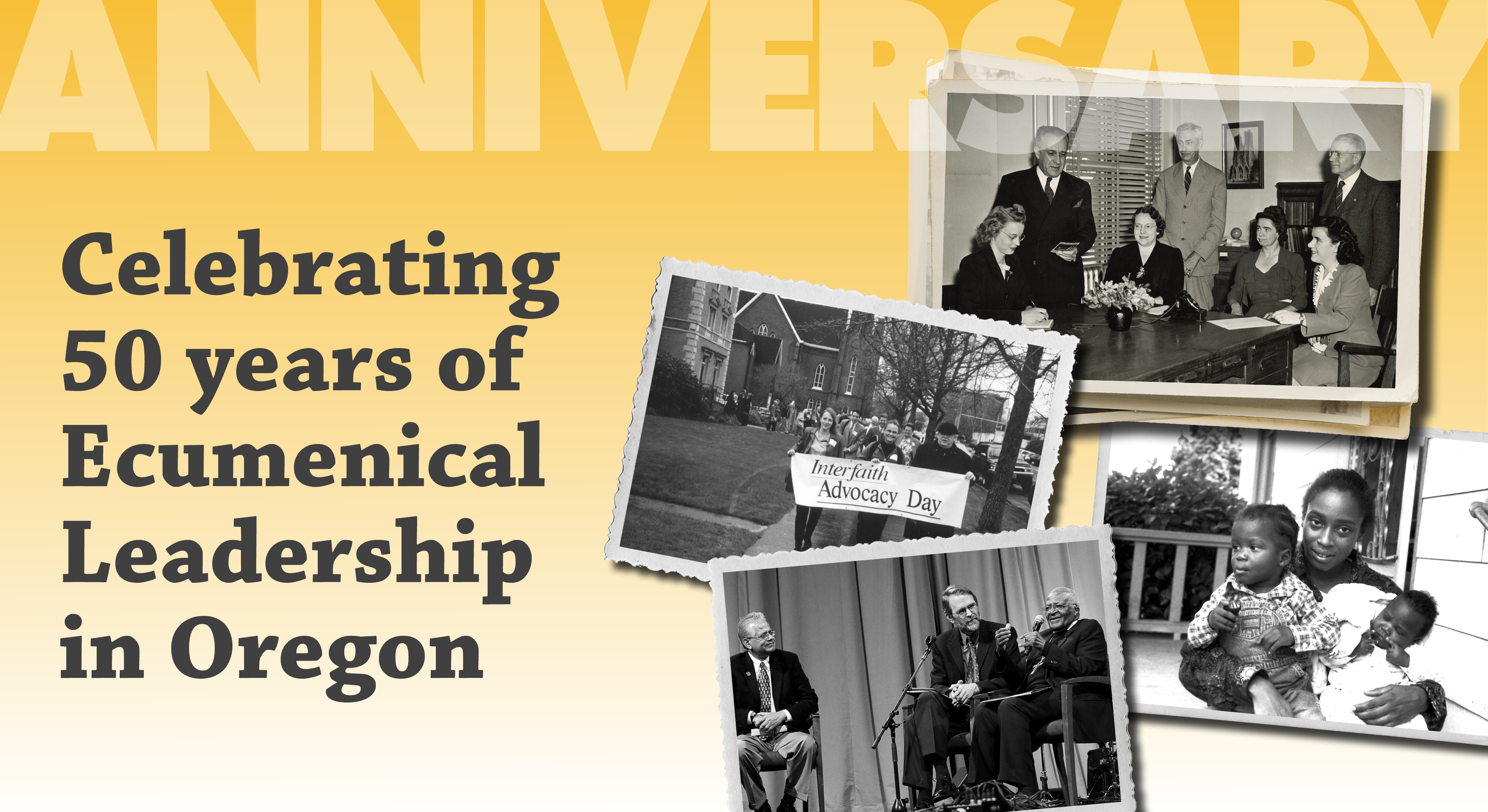
Each generation is challenged to hear and respond to the clarion call for justice. Ecumenical Ministries of Oregon (EMO) came into existence in response to this call. In 1974, the Greater Portland Council of Churches and the Oregon Council of Churches merged to form Ecumenical Ministries of Oregon. The formation of EMO was a step in the journey of seeking to faithfully live out our mission: “Committed to mutual respect and understanding, Ecumenical Ministries of Oregon brings together diverse communities of faith to learn, serve and advocate for justice, peace and the integrity of creation.”
Today, more than half a century later, EMO has a unique role to play in our state by leaning into justice and love and standing in solidarity with communities and creation that are under attack. This is our history and our calling.
A review of the history of the ecumenical movement reveals that churches and religious institutions have gathered to address the welfare of their communities. From the time of the Acts of the Apostles and the epistles in the Christian scriptures, diverse and distant faith communities have united to care for the needs of one another. This has not been incidental but reflective of the very character of faith communities to provide care, hospitality and justice.
In every age and community, the church has been called to promote justice, reconciliation, dignity of all people and the integrity of all creation. When EMO was formed in the 1970s, our state and world were in the midst of war, ecological destruction, and social and economic inequalities. The consensus that confronted and defeated fascism abroad and strove to eliminate racism, nuclear proliferation and poverty was fractioning.
The churches in Oregon recognized their unique ability and role in gathering people from throughout the state to work together to address issues. That legacy of mutual support helped EMO to work in and with various communities to address social issues—both those issues that were long standing and those that were emerging.
Today, EMO is uniquely situated to build on the legacy of caring by leaning into justice and love and standing in solidarity with marginalized communities under attack: migrants, refugees, asylum seekers, LGBTQIA+ people, women, Black, Indigenous and People of Color. Our religious institutions comprise people of all political perspectives and, in our best moments, we can work together because of a foundational belief that we are called to care and support each other and creation. EMO’s direct services programs and public policy advocacy are ways in which we do the work of justice.
At a time when too many refuse to speak up on behalf of those who are silenced, at a time when too many institutions are unable or unwilling to live out their calling, EMO must continue to resist the forces of oppression, pursue justice and keep our eyes on our vision: communities of faith in ministry together creating a more peaceful, just, sustainable and compassionate world.
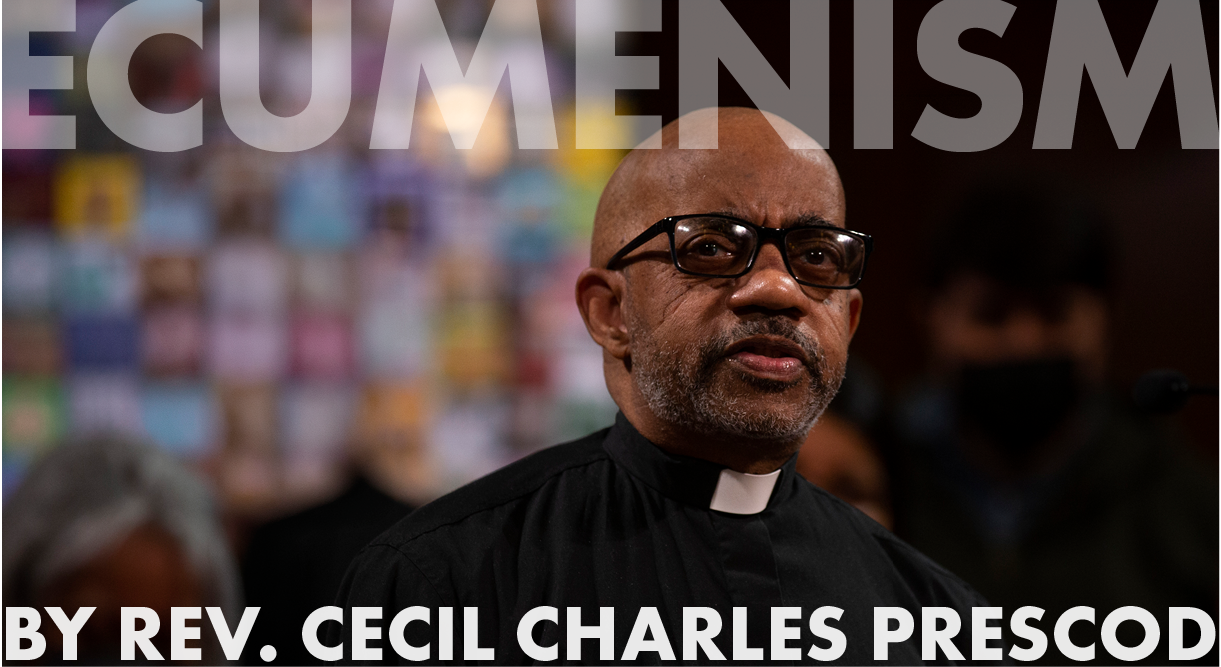
Written by The Rev. Cecil Prescod, is a retired United Church of Christ pastor, serving 13 years as minister of faith formation and two years as associate pastor at Ainsworth United Church of Christ (UCC) in Northeast Portland. He is a current member of EMO’s Board of Directors and chair of EMO’s Public Policy Advocacy Committee, on which he has served since 1993. Prescod was honored as “Ecumenist of the Year” at EMO’s Love in Action Gala on Oct. 15, 2026, for his decades of social justice advocacy on behalf of our communities.
Prescod came to Oregon 40 years ago. He co-founded People of Faith Against Bigotry in 1992 to defeat Ballot Measure 9, building a grassroots interfaith coalition of Muslim, Jewish, Protestant and Catholic communities. For over three decades, he has hosted “More Talk Radio” on KBOO, using the airwaves to educate and advocate. At Ainsworth UCC, he helped his congregation show up for those facing poverty, people of color and LGBTQIA+ community members.